
While the rest of the games world was busy with Summer Game Fest, Steam Next Fest, and Frosty Games Fest, we spent June heads-down on tooling and infrastructure. There’s new Story Solver and voice-over tool progress to show off, the results of our annual engine survey are in, and we won an award! Read on!
Yarn Spinner for Unity#
First up: we automated how we build our .unitypackage files. Until now this was mostly done by hand, every release: one package for the open source release, one for the Asset Store, one for each paid add-on, and then the embedded packages that get stored inside some of those packages. It was tedious and easy to get wrong, and we’d been putting off fixing it for ages.
Jon built a tool that produces all of them for us. We hit a button, out come the packages. Yarn Spinner for Unity 3.2.4 last month was the first release shipped with it, and this month it got finished off properly. It’s part of the release-process work we said we wanted to do back in the January update: releases that are less work for us are releases you get sooner.
We also started on a ReWired integration. ReWired is one of the most popular input systems on the Asset Store, and the integration will be part of Yarn Spinner+ for Unity — that’s where our integrations with paid assets live, since it seems fair that support for paid assets sits in the paid part of Yarn Spinner. Yarn Spinner+ already includes a built-in integration with Text Animator for Unity, as well as the Snaaake and Classic RPG dialogue presenters that shipped last month.
Source Generators#
Last month we mentioned a pile of source generator work heading towards one of our most-requested features ever. Here’s the headline: in an upcoming release of Yarn Spinner for Unity and Yarn Spinner for Godot (C#), your commands and functions will be able to take whatever parameter types you want. Your method signatures will no longer be limited to strings, numbers, bools, and a handful of engine types — if Yarn Spinner already knows how to convert something (say, a GameObject, found by name), or you’ve written a small converter for your own type, you can put it straight in your method and it’ll just work. Actions will also be callable on instances as well as statically, and you’ll get much better error messages when something about an action is wrong.
Tim spent most of June making this real, which meant rewriting our source generator as a modern incremental source generator (not AI). He hit enough surprises along the way that we’ve written the whole thing up as its own post — if you’re building Roslyn source generators yourself, or just enjoy a good war story, read Incrementing Our Way To Glory.
Yarn Spinner for Godot#
Yarn Spinner for Godot (GDScript) took big steps towards beta this month. A pile of bug fixes landed, and the samples we’ve been porting over from Unity got their full scenes — so instead of dialogue running in an empty grey room, each sample is now the little game it’s meant to be. There’ll be a samples browser right in the Godot editor: hit Play to see a feature working, or open the scene to see how it’s built.
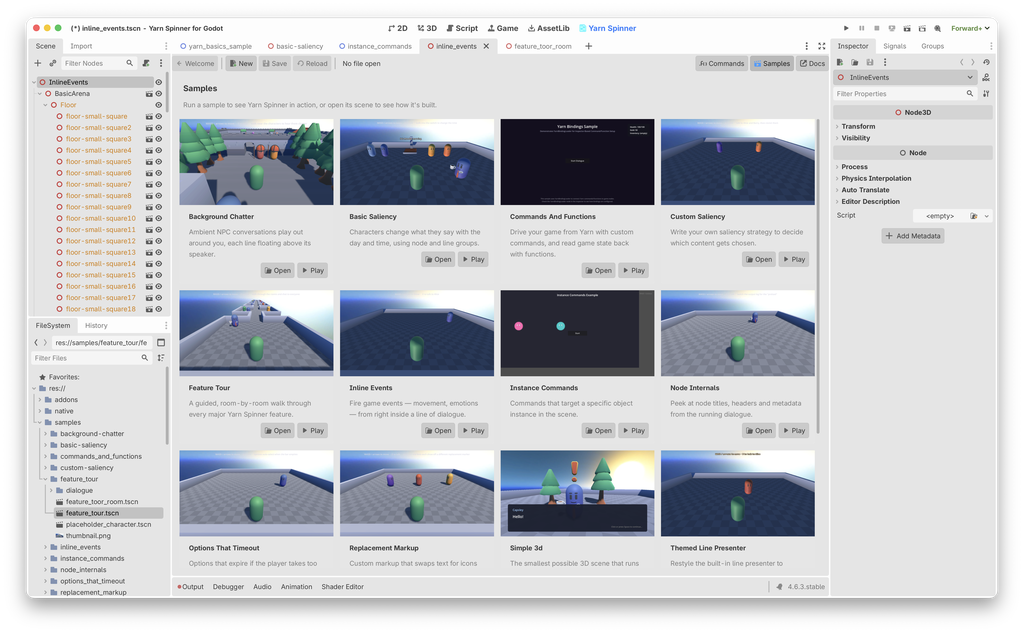
Beta, for us, means “no breaking API changes unless absolutely necessary”. With the samples in, the main work left is documentation, and then full release — hopefully a month or two after beta. If you want a feel for it right now, you can play one of the ported samples in your browser.
People are already making games with it, too — before we’ve even called it beta. Here’s [null band games], using Yarn Spinner for Godot (GDScript) to hold a conversation with a sentient factory (they’ve also written a post about how they built it):
(Making something with it? Tell us!)
A quick word on why we ship two Godot versions at all: we love C#, but not every Godot project wants the .NET runtime, and GDScript is where a huge part of the Godot community lives. So Yarn Spinner for Godot (C#) and Yarn Spinner for Godot (GDScript) are parallel, first-class versions of the same thing, and the goal is for them to be completely interchangeable: same features, same behaviour, pick whichever suits your project. The C# version is getting these samples, and plenty of attention generally, over the coming months too.
Story Solver#
Good progress on Story Solver, our tool for finding the parts of your story that players can never actually reach. Last month was about connecting the frontend and backend; this month was about building the backend out properly. Nearly all of it is now implemented, including GitHub-backed storage, so your projects live in a repository that you own.
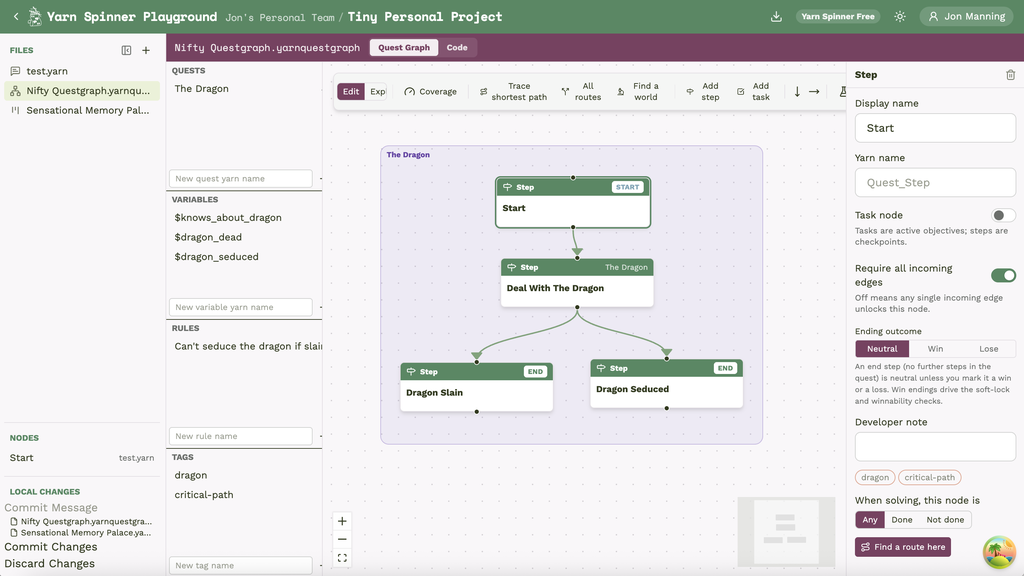
Still aiming for release towards the end of the year.
Voice-Over Tooling#
We started working on voice-over tooling after a VO-heavy client project last year, and showed off an early ‘Audio Slicer’ prototype in the February update.
This month it became a proper project: we’ve been talking with a studio that’s particularly interested in how this works, so we’ve picked it up and charged forward. We’re building tooling that keeps track of lines in different states of recorded-ness, handles sessions and takes, and matches recorded audio back to the written lines it belongs to. That last part is the hard one — scripts keep changing after lines are recorded, takes pile up, and keeping hundreds of audio files matched to the current text of every line is a job most teams end up doing by hand.
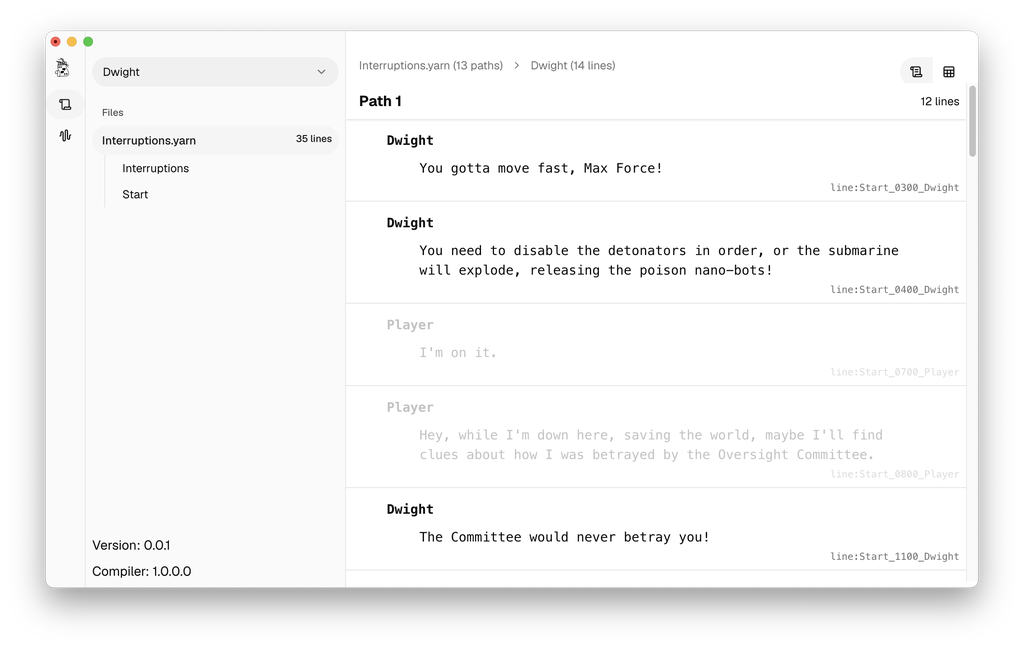
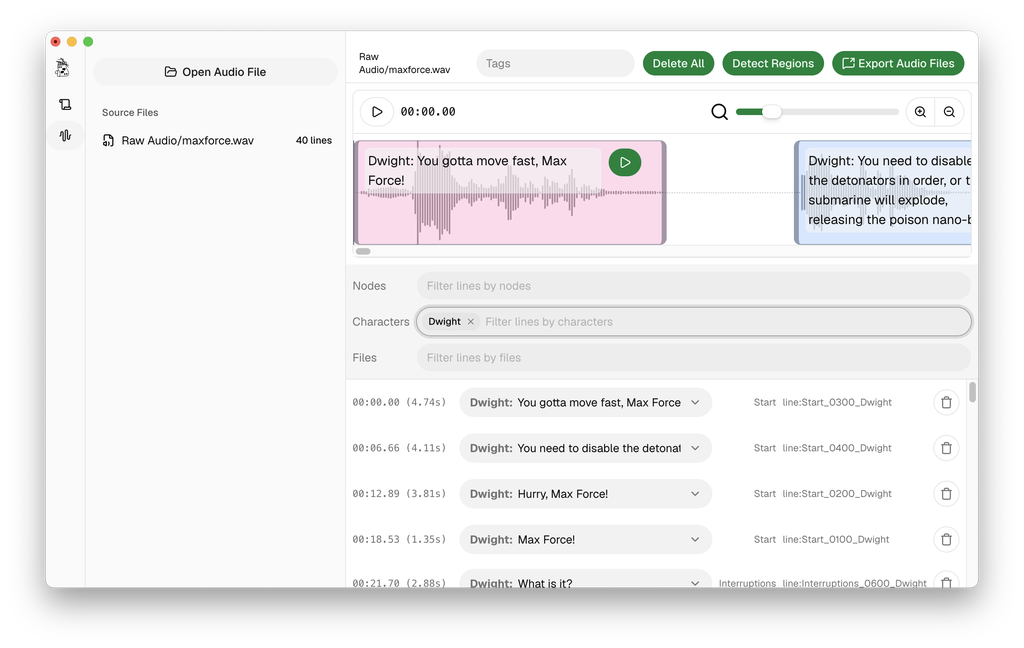
More on this in the coming months as it takes shape.
Business Business#
Just one item this month, but it’s a good one: Big Plans, the financial literacy game we made for Bank of us and shipped in April, won the Social Innovation Technology Award at the TasICT 2026 Excellence Awards! The judges described it as “financial education delivered as a genuine public good, built entirely in Tasmania”, which is exactly what we and Bank of us set out to make. We put months of work into that game, and it was the first shipped title built with our upcoming Visual Novel Kit, so this one means a lot to us.
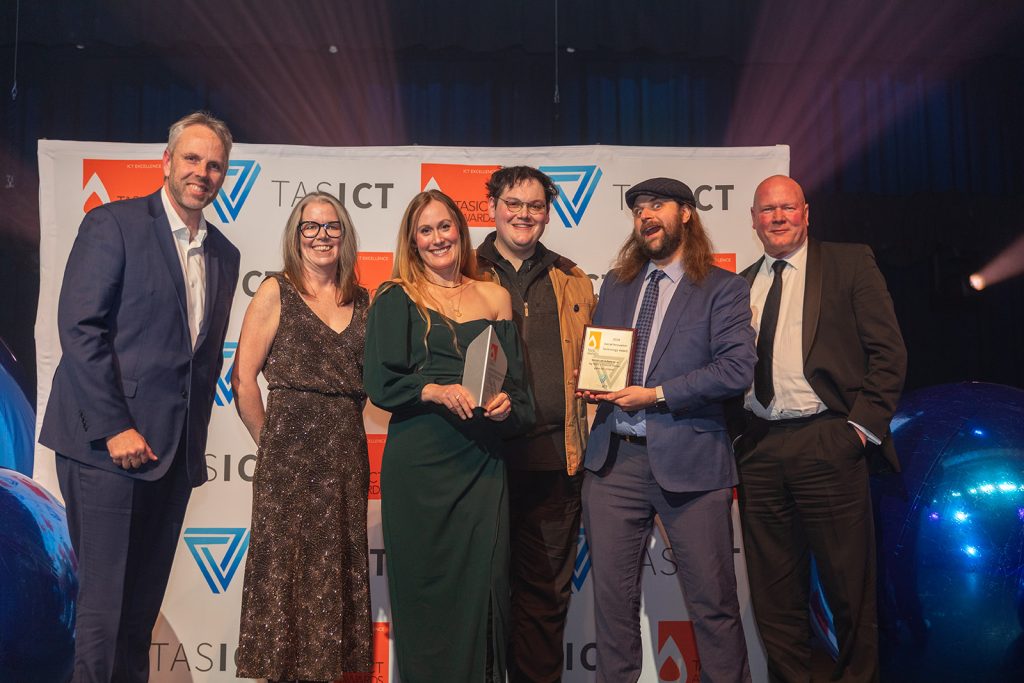
As ever: if you’d like us to build something for you, that’s literally what we do.
The Engine Survey#
At the end of the May update we asked you to answer our annual engine support survey on Discord: one question, which engine(s) are you using Yarn Spinner in, answered by tapping reactions. Thank you to everyone who responded! We run this every year, and it’s the single biggest input into which engines and versions get our attention. Here’s how it came out — one bar per engine, everything on the same scale, older versions on the left. (You could pick more than one, so the numbers overlap.)
A few things jump out at us. Unity users have largely moved to Unity 6, with 6.3 well in front — and noticeably fewer people still on Unity 2022 than we’d expected. The GDScript version of Godot is already the most-used non-Unity version of Yarn Spinner, before it’s even reached beta, which tells us the bet we made on it back in January was the right one. Unreal users are mostly on 5.7 or later. And 14 of you are using the community Bevy integration, which is delightful.
Speaking of Unreal: it’s great seeing people already building things with the alpha of Yarn Spinner for Unreal Engine. Here’s Alan, who’s driving a camera system and a full inventory from commands written in his dialogue:
These numbers directly shape what we test against and prioritise, so if you responded: thank you.
Other Fun Stuff#
As predicted, June was huge for showcases: Summer Game Fest, Steam Next Fest, and Frosty Games Fest all ran this month, along with a whole constellation of smaller showcases around them. We went through the lot, and Yarn Spinner games were everywhere. Here’s just a few of the ones we spotted:


NarraScope, one of our favourite events, ran in Albany, New York this month, and it was great to see Yarn Spinner-related talks in the programme.
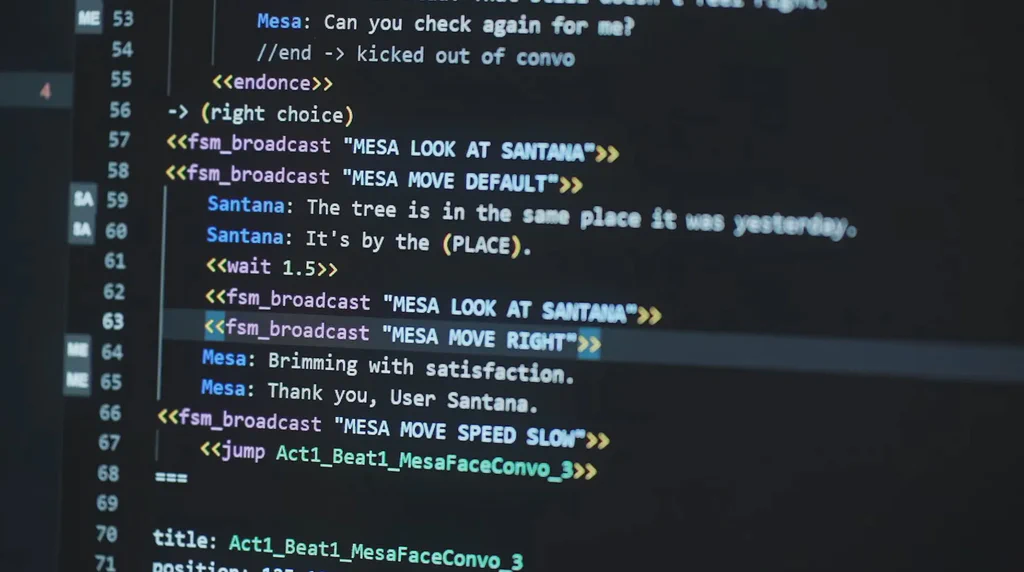
One more that made our whole month: during Day of the Devs, the trailer for Prove You’re Human from sunset visitor 斜陽過客 (the team behind 1000xRESIST) put an actual Yarn Spinner script up on screen. If you pause the trailer you can just sit there and read it. We are going to be very normal about this.
Summary#
- We automated production of our
.unitypackagefiles, for everything from open source releases to paid add-ons, and used the new tool to ship 3.2.4. - Started a ReWired integration, coming to Yarn Spinner+ for Unity along with other paid-asset integrations.
- Rewrote our source generator as an incremental source generator: no reflection, custom parameter types in actions, instance method support, and better error messages. Nearly working, shipping in future releases of the Unity and Godot (C#) versions.
- Godot (GDScript): lots of bug fixes, sample scenes ported across, beta soon, full release hopefully a month or two after. Godot (C#) remains first-class and gets the samples too.
- Story Solver: nearly all of the backend implemented, including GitHub-backed storage. Still on track for later this year.
- The VO prototype from February is now a real voice-over tool in active development.
- Big Plans won the Social Innovation Technology Award at the TasICT 2026 Excellence Awards!
- The annual engine survey results are in: Unity users are mostly on Unity 6, and Godot (GDScript) is already our most-used non-Unity version.
That’s June. See you next month!
Header image: forests in the Central Highlands of lutruwita/Tasmania, taken by Paris Buttfield-Addison. Ancient forests like these are under active threat from native forest logging.
Unless otherwise noted, the content of this post is licensed under Creative Commons Attribution-NonCommercial-ShareAlike 4.0 International (CC BY-NC-SA 4.0). Logos, screenshots, and artwork shown in this post remain the property of their respective owners and are not covered by this license. The Yarn Spinner logo and branding imagery are also not covered by this license.