
We recently posted a huge list of goals for Yarn Spinner in 2026 (read the roadmap here) and we’ve already been hard at work on them this January. So here’s what we’ve done so far!
Improving the Yarn Spinner Writing Experience#
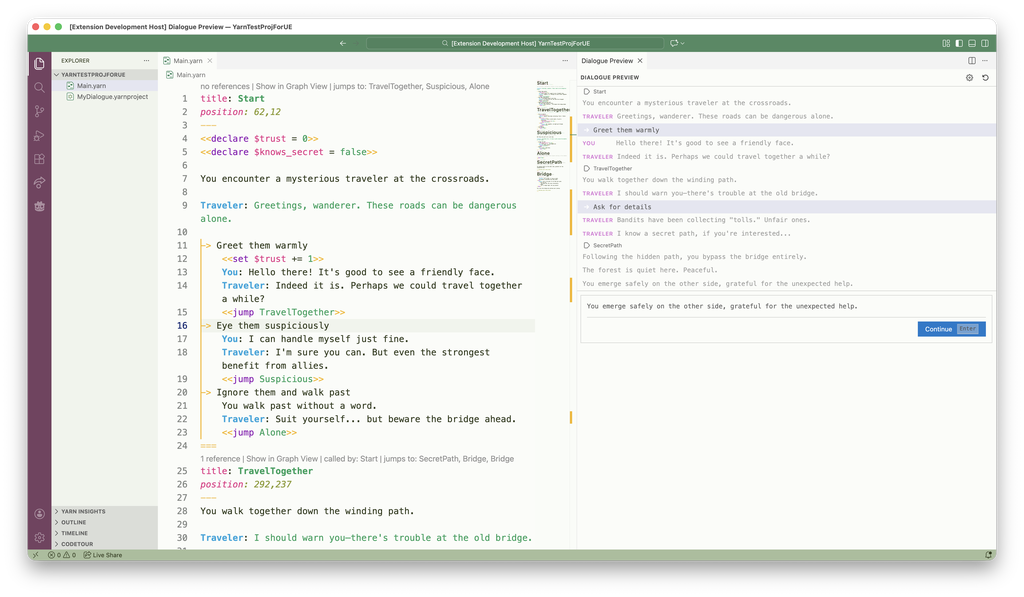
The VSCode Extension rewrite is almost done! It’s been released to a closed beta group this week, and when we’ve actioned any bugs or pain points they find, it will be ready for public release in the next few weeks.
This new version is mostly about quality-of-life and performance improvements—making the editor faster, cleverer, and more reliable—but you’ll notice a few snazzy features like inbuilt themes, new ways to edit and layout the graph preview, way more settings, and a customisable dialogue preview system (we’ll share more about this soon). With its release, we will also be adding the extension to OpenVSX to allow its use with compatible VSCode alternatives like VSCodium, and writing some guidance on how best to customise your editor for a perfect individualised writing experience (and turn off all that Copilot junk permanently, ugh).
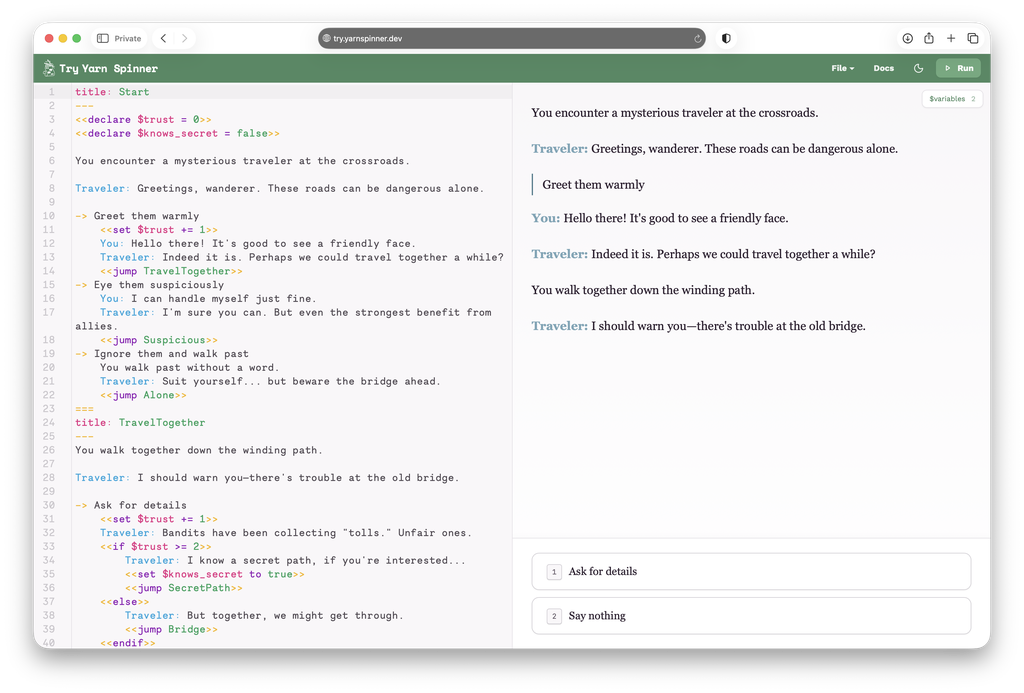
Alongside the update to the VSCode extension, we have made our online lite editor Try Yarn Spinner more consistent in features and look. This is out now.
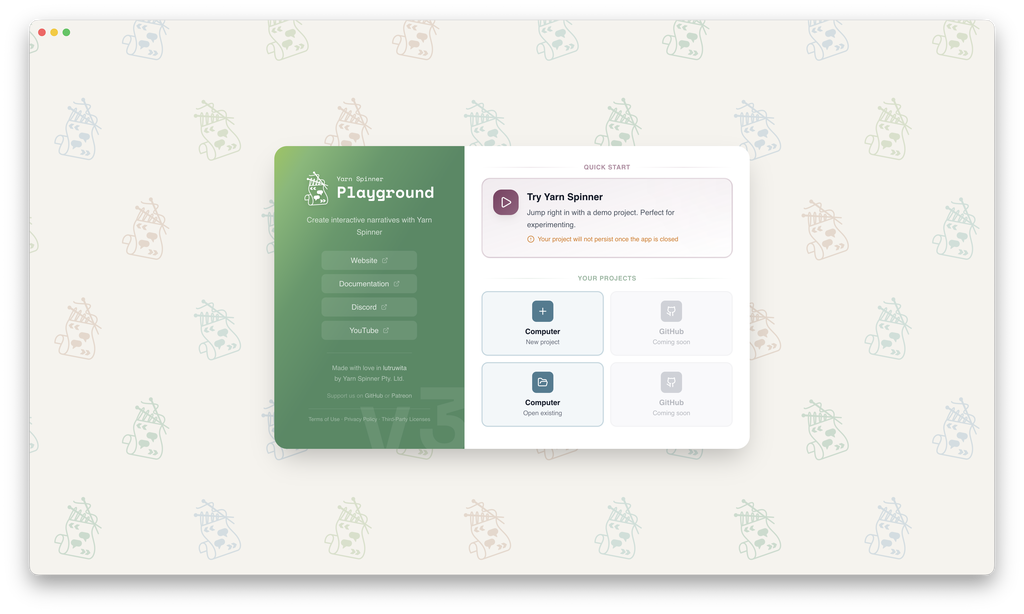
We have also made significant infrastructure developments—increasing the code that is shared between these editors and modularising it to use elsewhere—as part of our work towards our still in-development standalone editor for web, desktop, and possibly iPad: Yarn Spinner Playground. This fully-featured app will support both in-engine (e.g. Unity, Godot, Unreal) workflows, and developing standalone web-based games using Yarn Spinner, as well as integrating with our upcoming narrative planning and testing platform Story Solver.
This part is still a few months from public release, but it’s been conspicuously bug-free so far—which we, as programmers, find super sus.
Finishing the Unreal Version#
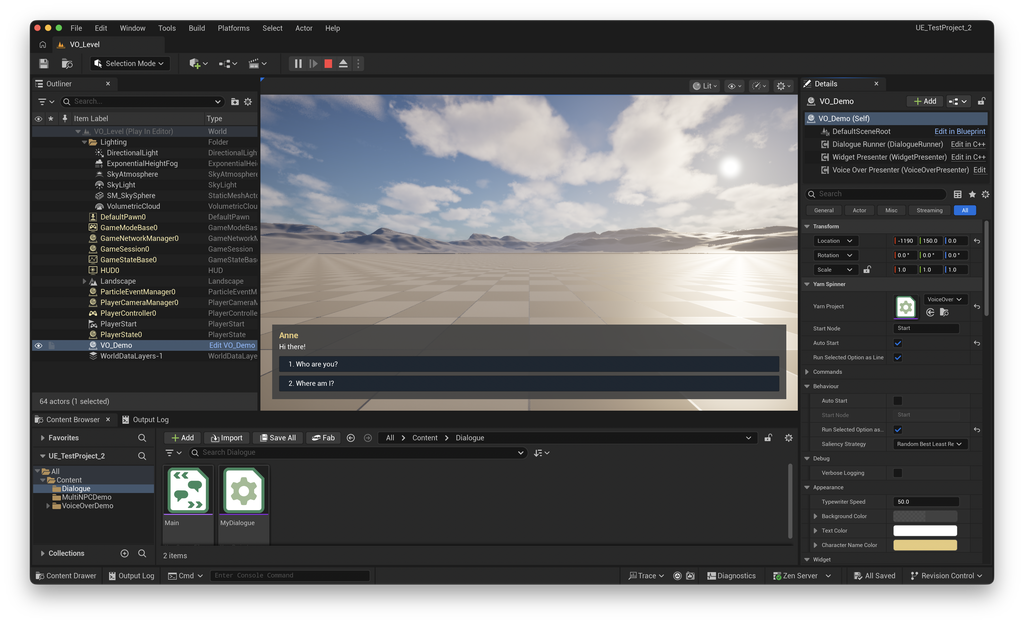
Our goal for this project from the start was feature parity with Unity: same behaviour, same in-engine features. That if you’d used Yarn Spinner in Unity before, you should feel right at home with the Unreal version. We’ve hit many a bump on the road to making something that feels Unreal-native, and struggled particularly with the compatibility of dependencies, and this has now led to an almost complete rewrite for UE5 support to meet our standards.
We’re very happy with the state the project is in now. We built everything around Unreal’s component model, execution uses continuations rather than coroutines, and everything is Blueprint-accessible so you can build a complete dialogue system without touching C++ at all if you don’t want to.
It’s all working great, so now we’re up to drawing the rest of the owl: making tests, nice in-built views, samples, docs, etc. It should be usable within the month, and ready for release by mid-year.
Making a GDscript-Only Godot Version#
We love C# but we know not everyone does, and the slow progress of the C# version of Godot has meant that using Yarn Spinner (and therefore the C# version of Godot) can come at the cost of flexibility or compatibility elsewhere in your project.
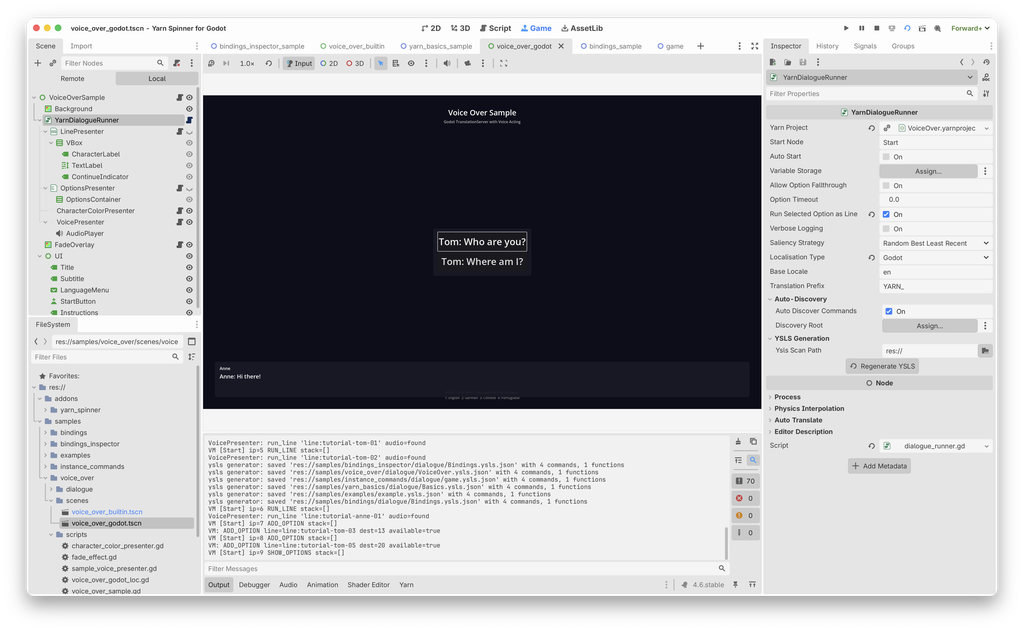
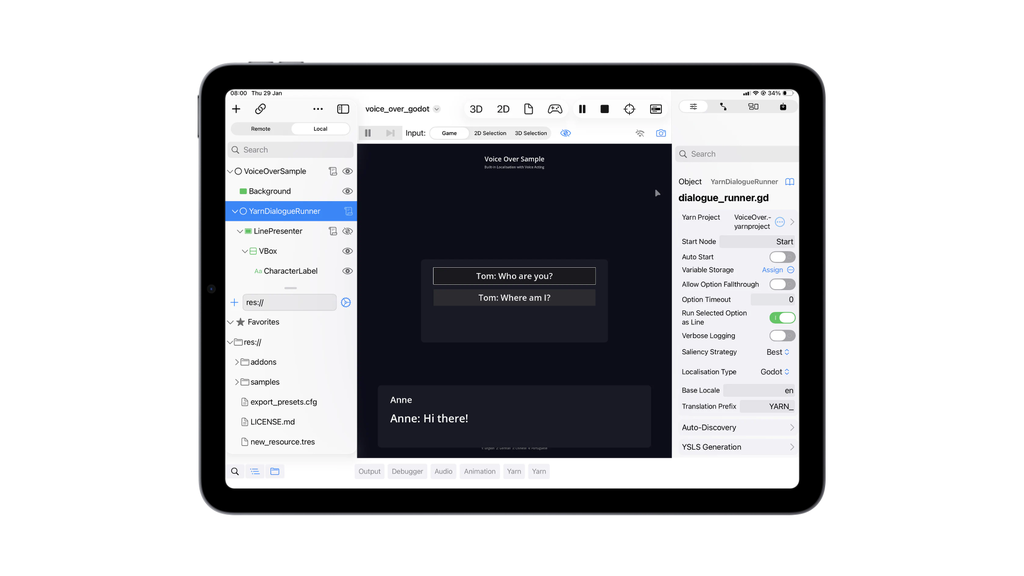
We’d rather people be able to choose C# or GDscript based on their own preference and the needs of their project, so we’ve been working on a full GDScript port of Yarn Spinner for Godot. No GDExtensions, no external dependencies, just pure GDScript that works everywhere Godot does—including on Xogot, fully running on an iPad! Using native GDscript means this version doesn’t require the .NET runtime! This will ship alongside the existing C# version for Godot (which we maintain in partnership with the amazing Decrepit Games), so you can choose between two first-class options.
This version of the plugin is still a few months away while we properly collaborate with our Godot users and community maintainers, and finish some of the projects above.
In Yarn Spinner, you can register methods which can be run by commands or functions from Yarn. These can be registered manually, but in C# (in Unity or Godot) we also offer automatic registration where you can mark a method [YarnCommand] and we will use minutiae of C# to discover and register those commands and functions for you. But GDScript doesn’t have that ability.
Best we can come up with, we can search methods by name. In this case, you’d need to name your methods _yarn_command_commandname or _yarn_function_functionname to be discovered. Does this sound like a silly idea to you? Do you have a better idea? Let us know your thoughts on the Discord.
We will also be adding YSLS generation to both versions of the Godot plugin, which is a file that tells the editor about the types and parameters of your registered commands and functions. This allows for more sophisticated autocomplete and validation as you write these in Yarn. In the future, we plan to make it easier for any tools to generate and make use of these files.
Yarn Spinner for Unity 3.2#
We’ve got another minor version ready to ship with loads of small improvements and bugfixes:
- Yarn commands and functions have parameter-level validation now that will tell you off well before a runtime error
- Support for better type-hinting in VSCode. This also laid the groundwork for Yarn Enum parameters in commands and functions which will come soon, but now you can at least type-hint to the editor that it should be a known Enum value
- Unity Localization tables can now be sorted (finally lines will be in the order they are in the yarn!) but you’ll have to turn this on in the Project Settings because it’s a bit slower than the default method
- Better logic to identify assets which should associate with dialogue lines (like VO files), so mis-matches are much less likely
- Improvements to markup parsing! Reworked how markup handles unbalanced tags, locale-dependent interpolation
- Project import now updates asset addresses and runs code generators after import completes, rather than during the import which was causing warnings
- Improved communication between Unity and VSCode!
Behind-the-Scenes#
We’ve almost finished spec-ing a major overhaul of our the Virtual Machine that is responsible for running compiled Yarn programs in-engine. The way it currently supports async behaviour is a huge hack and has loads of edge cases, and we have a good idea of how to make it natively async. This will finally allow us to have blocking functions (like “roll this dice on screen then return to running dialogue dependent on the outcome of that”)!
We’ve done a bunch of investigation into better ways to integrate dependencies and improve our build/test processes. Given some work, we think we can make releases much nicer for us and faster for you.
Last year we finished plumbing work for Story Solver to be available as an online service—handling logins, payments, sessions, collaboration and sharing, and so on. We’re about to begin on the supporting work for this like samples and docs ahead of the planned closed beta period.
We’ve also done some of what we call “Business Business”:
- We launched a new website late last year and we’ve added lots of new content to it this month, including multiple blogs like this one and a huge amount of entries in our new Games Showcase (we still have many more to add, and if you want to be included you can submit here).
- We’ve been in talks with a really cool game artist to commission some artwork for the website too!
- We’ve worked on some client projects! We’re about to release an educational game for teaching kids money-handling and financial literacy that we have developed in collaboration with a local bank. And we’ve been in conversation with multiple studios about lining up Yarn Spinner support work for 2026.
- We got a head start on our company taxes because we swear we’re not leaving it to the last minute this year. Please clap.
Fun Things#
We’re much of the board of our local game developers’ organisation which has been helping to organise a local games exhibition with the state government. We’ve also been prepping new content for regular events we do speaking to kids about gamedev and careers in tech.
Our playable museum installation celebrating ’90s game phone help lines, Hint Line ‘93 is now open at ACMI but will be leaving when the Game Worlds exhibition ends in late March so now’s your chance to got play it!
Our creative lead Paris has been hard at work on the Program Committee for this year’s NarraScope conference, a super awesome event for anyone involved in game narrative. Their CFP closes literally today, so get on it!
We’ve also seen some great Yarn Spinner games come out this month, including the adorable Cozy Caravan and the frog-tacular Big Hops! And we absolutely cannot wait for next month’s release of the long-awaited (cancelled and then heroically un-cancelled) TripleTopping narrative game: Dead Pets.


Summary#
- New Try Yarn Spinner out now, major VSCode Extension update in a few weeks, standalone editor sometime this year
- Unreal Version usable in weeks, release-ready in months
- Unity Version bugfixes and performance improvements coming soon in 3.2, more to come throughout the year
- Story Solver closed beta and Visual Novel Kit add-on release will be the next projects to move to the forefront of our queue
- Godot GDscript Version has had a lot of work done this month, is now going through community review, will return to priority later in the year (but if you really want to use it in its rough state, get in touch and we’ll consider)
Header image by our very own Jon Manning, during the recent evenings of high Aurora Australis (southern lights) activity.
Unless otherwise noted, the content of this post is licensed under Creative Commons Attribution-NonCommercial-ShareAlike 4.0 International (CC BY-NC-SA 4.0). Logos, screenshots, and artwork shown in this post remain the property of their respective owners and are not covered by this license. The Yarn Spinner logo and branding imagery are also not covered by this license.